
In a high-volume hospital environment, every second counts. When medical staff have to wait for sluggish imaging systems to load, or manually cross-reference photos with a disconnected Electronic Medical Record (EMR), patient care slows down.
Rumah Sakit St. Elisabeth, a leading healthcare provider in Indonesia, recognized that to maintain their high standard of patient care, they needed to modernize how clinical images were captured, stored, and analyzed across their departments.
They recently trialed CIM (Clinical Imaging App) to replace their traditional workflow. The results demonstrated exactly why cloud-native, integrated imaging is the future of hospital IT.
The Challenge: Speed and System Fragmentation
Before the trial, the clinical teams faced a familiar industry challenge:
- Slow retrieval: High-resolution medical photos took too long to load, creating friction during fast-paced patient consultations.
- Analysis limitations: Comparing a patient’s historical baseline photo with a current photo required clunky manual workarounds.
- Siloed data: Clinical photos were not communicating seamlessly with the hospital’s central patient database.
The hospital needed a solution that was not only incredibly fast but could integrate flawlessly with local Indonesian health data standards.
The CIM Solution: Built for Speed and Integration
During the trial, Rumah Sakit St. Elisabeth deployed CIM to bridge the gap between their clinicians’ mobile devices and their central EMR. The medical staff noted three immediate transformations in their daily workflow.
1. Lightning-Fast Data Loading
The most immediate feedback from the clinical team was their amazement at the platform’s speed. Because CIM is built on modern, cloud-native architecture, it completely eliminates the buffering associated with legacy PACS plugins. Medical staff were able to pull up heavy, high-resolution patient files on their mobile devices and clinical tablets in a fraction of a second.
2. Advanced Image Comparison and Analysis
Capturing the image is only half the battle; analyzing it is where diagnostic value is created. The medical team heavily utilized CIM’s Instant Compare Tool. This feature allowed doctors and nurses to pull up historical and current patient photos side-by-side on the same screen instantly. Whether tracking wound healing progression or analyzing dermatological changes, the intuitive interface empowered the staff to make faster, more confident clinical decisions.
3. Seamless Integration with the Patient Database
A clinical imaging tool is useless if it creates an isolated data silo. A critical success factor of the trial was CIM’s ability to natively integrate with the hospital’s existing patient database system running in Indonesia.
Instead of manually typing in patient data, staff could rely on a synchronized system where every photo and digital consent form was automatically bound to the correct patient file. This deep integration ensures compliance with local health data regulations (like Indonesia’s UU PDP and Permenkes No. 24 of 2022 regarding Electronic Medical Records) and provides a single source of truth for hospital IT.
The Result: Faster Decisions, Better Patient Care
The trial at Rumah Sakit St. Elisabeth proved that modern clinical imaging doesn’t have to be heavy, slow, or disconnected. By moving to CIM, the medical staff removed the technical friction from their day, allowing them to focus entirely on patient analysis and care.
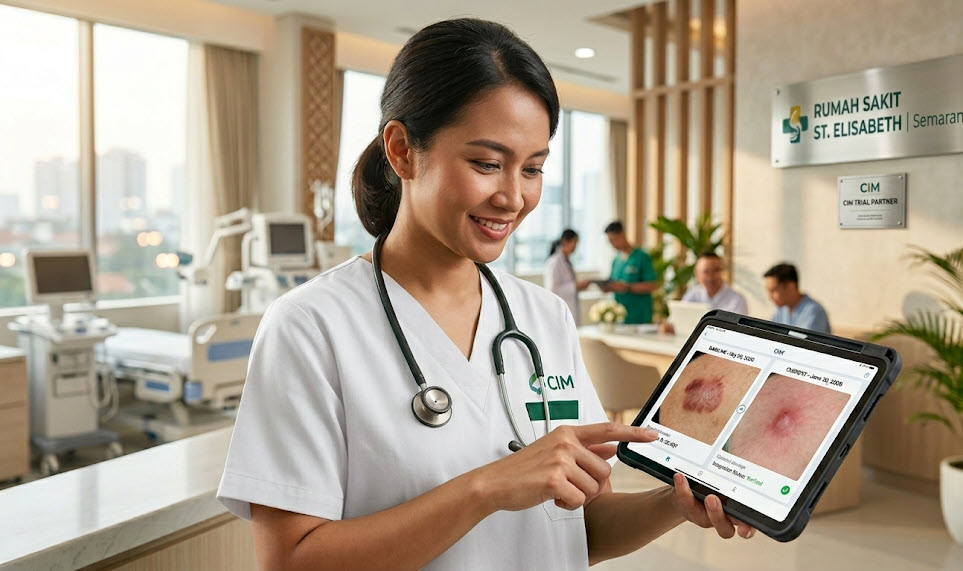
“The speed at which CIM loads image information is incredible,” noted the Clinical Nursing Team during the trial. “It allows our nurses to have exact visual data ready instantly, enabling us to make faster diagnoses and proceed directly to treatment without delays.”
Is Your Hospital Ready to Modernize?
If your clinical staff is frustrated by slow image loading and disconnected EMR plugins, it is time to upgrade your infrastructure.
Book a fast, no-pressure walkthrough of CIM today to see how our sub-second compare tool and native EMR integrations can transform your hospital’s workflow.